

Research
Non-equilibrium quantum dynamics |
|
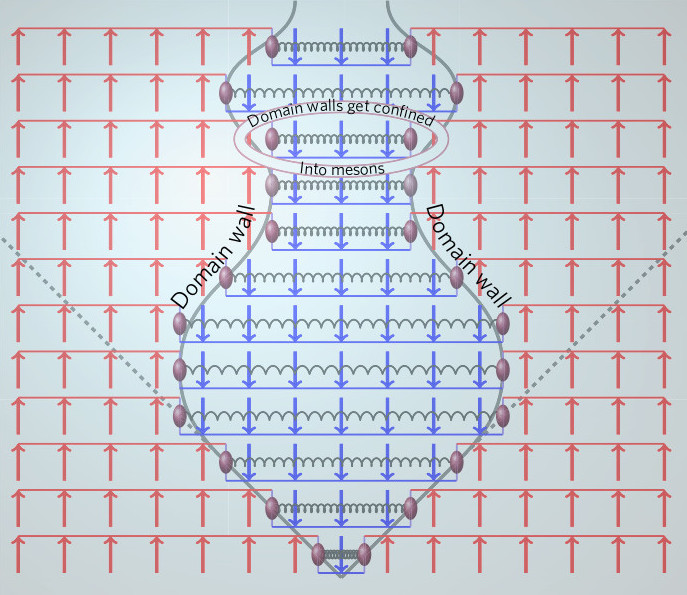 |
Predicting the time evolution of quantum systems after initialized in a non-equilibrium state has posed a major challenge to researchers since the birth of quantum mechanics. In general, exact methods are only present for small or non-interacting systems. However, exact or very efficient methods (e.g., bosonization, Bethe-ansatz techniques, matrix product state algorithms) have been developed in the past decades which methods can be applied in one-dimensional systems. These methods enable for the study of fundamental phenomena like non-equilibrium transport, thermalization, or the development of non-equilibrium steady states in these systems.
Figure reference: M. Kormos , M. Collura, G. Takács, and P. Calabrese, Nature Physics 13, 246–249(2017). |
Strongly correlated quantum systems |
|
 |
The structure of many-body quantum states that appear in strongly interacting quantum systems is of great interest to researchers. The strong interactions lead to strong quantum correlations between the constituents of these systems. Good examples for such states are the Luttinger liquids in one dimension or the Wigner crystal state of electrons with strong Coulomb repulsion. State of the art experimental techniques with cold atoms or nano-sized devices allow for detailed experimental investigation of these systems, and the rapid development of the experiments motivates also the theoretical research. Strongly correlated states are usually hard to describe because these states usually cannot be reached by perturbation theory around the non-interacting limit.
Figure reference: I. Shapir, A. Hamo, S. Pecker, C. P. Moca, Ö. Legeza, G. Zaránd, S. Ilani, Science 364, 870-875 (2019).
|
Tensor network based simulations |
|
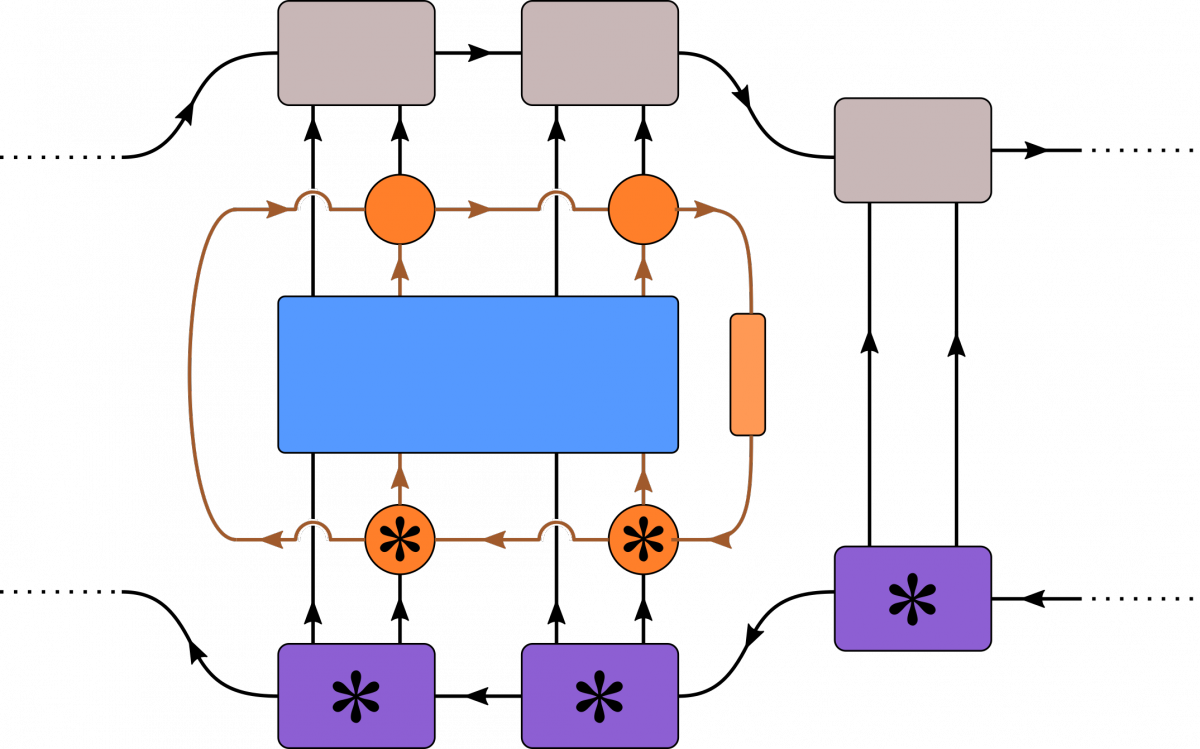 |
Classical simulation of quantum systems with our digital computers can be performed, in general, rather inefficiently due to the exponentially large many-body Hilbert space. However, the physically relevant quantum states (for example, low energy states of systems with local interactions) can be treated more efficiently if one exploits the fact that quantum entanglement is usually weak in these states. The weak entanglement enables for tensor network representation of these states. Various algorithms have been developed for tensor network states in the last three decades (e.g., DMRG for ground state calculations, TEBD or TDVP for real time simulations) promoting tensor network approach to be one of the most versatile numerical tools for physicists. We have also developed sophisticated algorithms in which we can exploit Abelian and non-Abelian symmetries of the system or simulate open systems that are coupled to an external heat bath.
Figure reference: M. A. Werner, C. P. Moca, Ö. Legeza, G. Zaránd, Phys. Rev. B 102, 155108 (2020).
|
Collaborations
We have fruitful long-lasting collaborations with researchers from around the world. A non-exhaustive list of our collaborators is presented below.
- Pasquale Calabrese (SISSA-Trieste)
- Mario Collura (SISSA-Trieste)
- Szabolcs Csonka (BME, Budapest)
- Jan von Delft (LMU, München)
- Eugene Demler (Harvard, Boston)
- David Goldhaber-Gordon (Stanford University)
- Shahal Ilani (Weizmann Institute)
- András Kruppa (ATOMKI, Debrecen)
- Örs Legeza (Wigner RC, Budapest)
- Felix von Oppen (Freie Universität, Berlin)
- Tomaz Prosen (University of Ljubljana)
- Pascal Simon (CNRS, Université Paris-Saclay)
- Ireneusz Weymann (Adam Mickiewicz University, Poznan)
Funding
Research funding
- NKFIH fund TKP2020 IES (Grant No. BME-IE-NAT) of the National Research, Development and Innovation Office - NKFIH
- Quantum Technology National Excellence Program of the National Research, Development and Innovation Office - NKFIH (Project No. 2017-1.2.1-NKP-2017-00001).
- ÚNKP-20-4 New National Excellence Program of the Ministry for Innovation and Technology from the source of the National Research, Development and Innovation Fund
- Ministry of Innovation and Technology and the National Research, Development and Innovation Office within the Quantum Information National Laboratory of Hungary.
Group affiliation for publications
MTA-BME Quantum Dynamics and Correlations Research Group, Eötvös Loránd Research Network (ELKH), Institute of Physics, Budapest University of Technology and Economics
Acknowledgments
All group publications (papers, posters, TDK/BSc/MSc/PhD theses)
This research has been supported by the National Research Development and Innovation Office (NKFIH) through the Hungarian Quantum Technology National Excellence Program under project no. 2017-1.2.1-NKP-2017-00001, and by the NKFIH fund TKP2020 IES (Grant No. BME-IE-NAT), under the auspices of the Ministry for Innovation and Technology. This research was supported by the Ministry of Innovation and Technology and the National Research, Development and Innovation Office within the Quantum Information National Laboratory of Hungary.
Logos (for talks, posters)
- BME and BME Physics logos: see top of this page, and also see
https://physics.bme.hu/internal_downloads
for those logos in various file formats and resolutions. - NKFIH

- HunQuTech

- ELKH


Links
- Webpage of the open source, flexible BME DM-NRG code.
- Long Range Colloquium - online seminars about latest developments in condensed matter physics and quantum information
- Szilárd Leó Colloquium of the BME Institute of Physics
- HunQuTech - a national research programme on quantum technology in Hungary
- QHungary site and QHungary facebook group - part of the group takes part in these quantum information-related educational and outreach activities